Sada-e-Watan Sydney ™
sadaewatan@gmail.com
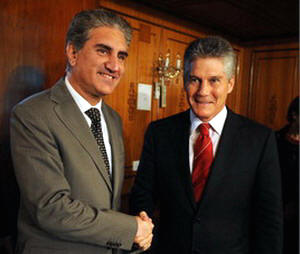
Shah Mahmood Qureshi & Stephen Smith
Australian Foreign Minister Sympathises with Pakistan
On the evening of Tuesday, 03 March 2009, the Australian Foreign Minister Stephen Smith called Foreign Minister Makhdoom Shah Mahmood Qureshi to condole with him personally and on behalf of the government and the people of Australia on the tragic loss of lives in the Lahore terrorist attack. The Australian Foreign Minister said that in this hour of grief, Australia stood shoulder to shoulder with Pakistan.
He said that Australia and Pakistan were close friends. He offered to send to Pakistan an Australian team to assist in the ongoing investigations into the terrorist attack. In this regard he mentioned that Australia has developed counter terrorism expertise including handling of forensic evidence and CCTV footage. Foreign Minister Qureshi thanked the Australian Foreign Minister and briefed him in detail about the incident. He also informed him that Trevorm Bayliss, Australian coach was safe in terrorist attack.




Interview of FM of Australia on ABC 720 Perth
(Subjects:
Terrorist attack on the Sri Lankan cricket team in Pakistan)
GEOFF HUTCHISON:
They arrived with guns and grenades; they shot up the Sri Lankan cricket team's
tour bus. Eight people died, six members of that squad were wounded. They
further shredded Pakistan's political and sporting reputation.
Stephen Smith is Australia's Foreign Minister. He joins me on the program.
Good morning to you.
STEPHEN SMITH: Good morning, Geoff.
GEOFF HUTCHISON: Mr Smith, you were in Islamabad as recently as two weeks ago. On the basis of what you saw then and on the basis of what's happened now, what's most concerning about these events?
STEPHEN SMITH: Well, what's most concerning now is what was most concerning two weeks ago, which is Pakistan has got very serious security and economy challenges and it needs the help of the international community as it tries to work its way through those challenges, those security challenges. I think what the terrible attack on the Sri Lankan team yesterday shows, or tells us, is that it doesn't matter what position you occupy or what game you play, if the threat of terrorism is there then you are at risk. And this has sent a shudder through the international cricketing community, as it sent a shudder through the world. But it just underlines that there is a very serious extremist and terrorist threat in Pakistan, in the Pakistan/Afghanistan border area and also in Afghanistan itself. And it's one of the reasons why Australia believes its acting in our national interest by making a contribution to try to stare down the terrorist threat in Afghanistan and in the Afghanistan/Pakistan border area.
GEOFF HUTCHISON: I also understand you've offered some Federal Police assistance this morning?
STEPHEN SMITH:
Yes. I spoke to Foreign Minister Qureshi last night, I conveyed obviously the
condolences of the Australian people for the deaths of the Pakistani police
officers and the bus driver. And I indicated to him that we were ready, willing
and able to provide the assistance of the Australian Federal Police in an
investigative and forensic sense. And Foreign Minister Qureshi was very grateful
for that offer.
Time will tell whether there is a need for Pakistan to take it up, but that was
a reflection of trying to enhance the relations between Australia and Pakistan,
but also seeking to render practical assistance at a, you know, at a very
difficult time.
I have to say that Foreign Minister was very wise, or attuned, to the existence
of Australians in the Sri Lankan touring party and was very readily able to give
me up to date information. Which confirmed what I'd got from our High
Commissioner late last night as well, that the five Australians associated with
the touring team, the two reserve umpires, Steve Davis and Simon Tauffel, and
the three coaching staff, Trevor Bayliss and his two colleagues, were all
unharmed.
There was a report yesterday that one may have been slightly injured, but
fortunately they're all well. They're obviously shaken and all shocked, but
they're all well. Simon Tauffel and Steve Davis arrived in the United Arab
Emirates last night and were met by our officials. And the other three are on
board the Sri Lankan Government's plane, which is about to land in Colombo with
the rest of the Sri Lankan team.
GEOFF HUTCHISON:
In a few moments we'll hear from Steve Davis, the umpire. He was in a mini-bus
following the Sri Lankan team bus.
Foreign Minister, Robert Baer, a former CIA operative and now a Middle East and
Central Asian analyst, said on his program that he thought Pakistan is now
falling to pieces. So, this is two days in advance of the events of yesterday.
Just have a listen.
ROBERT BAER: [Excerpt] Now, there's large parts, ungovernable spaces of the world. We - Pakistan will go under. Count on it. If this continues, unless there's some miracle, Pakistan will break up into five pieces, its five original provinces, which will be a total mess. [End]
GEOFF HUTCHISON: Do you share those concerns? Certainly the Indians have come out, perhaps predictably, by saying that it's declared Pakistan now has to dismantle what is an infrastructure of terrorism.
STEPHEN SMITH:
Well, let me make a number of points. For a considerable period of time the
international community viewed Pakistan as simply adding to the Afghanistan
problem because of the poorest nature of the Afghanistan/Pakistan border. When I
was in Pakistan a fortnight ago, I went to Peshawar and then flew through the
Khyber Pass, so I saw the difficult topography and terrain, and the poorest
nature of that border.
So, for a considerable period, Pakistan was viewed as simply being an aspect of
Afghanistan and needing to bring the border crossings under control. The
Australian Government and I have been making the point, for at least six months
from the second half of last year, certainly following the attack on the hotel
in Pakistan, that this was not just an issue that related to the
Pakistan/Afghanistan border. This was a threat to Pakistan itself.
When I spoke to President Zardari and to Foreign Minister Qureshi and the Chief
of the Armed Services, General Kayani, a fortnight ago in Islamabad, I was left
with the distinct impression that the authorities in Pakistan had come to the
conclusion that this was what we'd describe as an existentialist threat to
Pakistan itself. This was something that was threatening the Pakistan nation
state.
Pakistan is strategically very important, to South Asia, to the Middle East, and
to the rest of Asia. It's the second largest Muslim populated country in the
world and on current population projections will overtake Indonesia in the
course of the first half of this century. So, strategically, Pakistan is very
important and it needs the help, both on the security front and on the economic
front of the international community.
At the United Nations meeting in September last year, Australia became one of
the original mineral members of a group, United Nations group, called the
Friends of a Democratic Pakistan. And I attended that meeting with a range of my
colleague Foreign Ministers, and I think the attack yesterday just underlines
the point that the international community needs to give Pakistan all the
assistance it can as Pakistan tries to deal with a very severe terrorist and
extremist threat, which is compounded by very acute economic difficulties.
GEOFF HUTCHISON: Cricket Australia has to make some decisions. Due to play Pakistan in the United Arab Emirates, some talk of Australia maybe playing a three test series against Pakistan in England next year. Will you leave it up to Cricket Australia to determine its policy? We haven't toured there, formally, for more than 10 years. Are you comfortable that Cricket Australia will make the kind of decision you would like them to make on the future of cricket with Pakistan?
STEPHEN SMITH:
Well I think Cricket Australia and the international community need to obviously
bear and weigh very heavily in mind yesterday's terrible events. But I've had a
number of discussions with Cricket Australia about these matters, both with
their their executives, with their officers, but also, from time to time with
the players.
And I'll make a couple of points about Cricket Australia and its decision making
process in the run up to Cricket Australia deciding not to tour Pakistan. You'll
recall that when they, when Cricket Australia made that decision they were
criticised by some on the basis that somehow cricket was immune from such
activity. Well, yesterday has blown that argument completely out of the water,
literally.
GEOFF HUTCHISON: There might be a compelling argument that says because of its attractiveness, because of its status on the subcontinent, that people who play cricket might now be more sharply in focus as targets.
STEPHEN SMITH:
I've just come from a press conference and I've made the point that just as you
can regard the terrorist attack on Mumbai as being symbolic, the first attack in
India on essentially a financial centre and also on foreigners, you may well be
able to regard this as a symbolic attack, because it does deal with an iconic
game. Iconic not just to Australians but throughout South Asia.
But let me return to Cricket Australia. The Australian Government's approach is,
of course, we leave Cricket Australia to make its own decision, but we provided
Cricket Australia with all the most recent, up to day, relevant travel advice,
re threat assessments and security advice that we had, and they came to their
own conclusion that it was not in the welfare and interests of their players to
tour.
One impression I am very strongly left with, and this is to Cricket Australia's
great credit, is that at all times, when I've had dealings with them about these
issues, the thing that they hold uppermost in their minds and the thing which is
their highest priority is the safety and security and welfare of their players
and their travelling party, including spouses who often travel.
So, it'll be a matter for Cricket Australia to make judgements about future
tours of Pakistan or other places where where it is proposed or scheduled that
they play. But also what will now also very clearly come into play is that the
International Cricket Council, the international authorities, now of course need
to view yesterday's events very carefully and to make their own judgements about
previous scheduling arrangements that they have in play, including the proposal
for a world cup in 2011…
GEOFF HUTCHISON: 2011.
STEPHEN SMITH: … in India, Pakistan and Bangladesh.
GEOFF HUTCHISON: Yes. Stephen Smith, thank you for talking to me this morning.
STEPHEN SMITH: Thanks very much, Geoff.