Sada-e-Watan Sydney ™
sadaewatan@gmail.com

Pakistan &
Australia’s Foreign Ministers Joint Media Conference at Ministry of Foreign
Affairs Islamabad
(Subjects: bilateral
relationship, terrorism, Australian assistance for Pakistan, conflict in
Afghanistan)
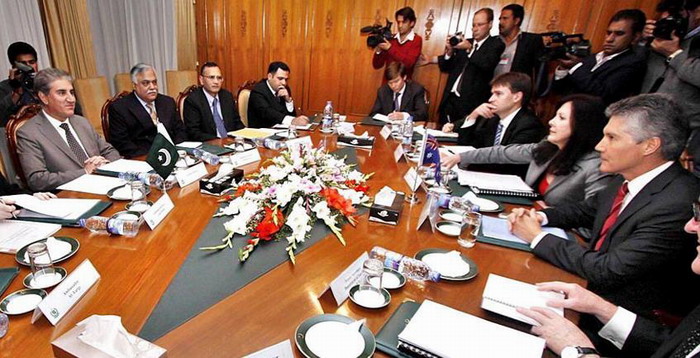
Shah Mahmood Qureshi: Let me begin by welcoming Mr Stephen Smith, the Australian Foreign Minister, to the Foreign Office and to Islamabad. I am delighted that the Australian Foreign Minister is a friend. We met a couple of times in New York and Paris and in the short interactions we have had we have developed a strong rapport. I have been talking to him and engaging with him in Islamabad. It is a very welcome visit because the last Foreign Minister visited us in 1998. So welcome to Islamabad.
We have had a long and frank discussion and we discussed our bilateral relations and discussed our defence cooperation. We also discussed cooperation between our intelligence, our law enforcement agencies, and examined opportunities for enhancing our bilateral trade and economic relations.
Australia is supportive of Pakistan on various regional and multilateral points. We share perceptions and there is a convergence of interests in a number of areas and we intend to build on the closeness that has been now within our thinking in the last few years and we want to build upon that. Australia is perhaps keener to focus on South Asia and that is a very welcome opportunity for Pakistan to pervade that new environment and atmosphere.
We also discussed the major challenges Pakistan is facing – we mentioned two of them: our fight against extremism and terrorism that is affecting not just the people of Pakistan but the economy of Pakistan as well. We also discussed how Australia can help Pakistan in reviving its economy which has been under stress for a number of reasons.
We also talked about Australia’s interest in increasing economic and aid assistance to Pakistan. They have announced it and they intend to do it more so in the days to come. Plus, in defence cooperation a four-fold increase in our army officers going to Australia for training, and Australian support for democracy and democratic institutions in Pakistan, support for a vibrant civil society in Pakistan is, again, a very welcome initiative.
We also talked about how we can cooperate in the fields of agriculture in particular because we both have semi-arid conditions and we grow crops which are common – cotton, for example is the mainstay of our economy and Australia grows very fine quality quality cotton and has expertise on that. We talked about double taxation, how we can enhance investment opportunities for Australians in Pakistan. I mentioned four areas that are open to Australian investment, which are mining, oil and gas, power generation and agriculture development. We also mentioned cooperation in multilateral forums. Then there are two MOUs we are working on collectively – an agreement between the Ministry of Narcotics Control and the Australian Federal Police, and the second is an agreement between the Federal Investigation Agency of Pakistan and the AFP of Australia. We are almost done with that and in principle we will sign that very soon. There are some procedural details to be worked out and hopefully we will overcome those details very soon and the agreements will be in place.
I also shared with the Foreign Minister the developments post-Mumbai incident and the initiative of Pakistan and the investigations of Pakistan. We also discussed Australia’s very keen interest in Afghanistan – they have their presence in Afghanistan, they have their troops in Afghanistan, so obviously they have an interest in the peaceful state of Afghanistan. Pakistan is equally interested in a peaceful state of Afghanistan and so I discussed the positive developments of late between Pakistan and Afghanistan.
One other interesting thing that we did discuss was inter-faith dialogue and the need to promote the true tradition of moderate Islam that is the Sufi approach to Islam, and hopefully Australia and Pakistan will be working on that to organise an international conference. Obviously it would take in Afghanistan as well, because I feel that it has a very strong tradition of moderate Islam – this Sufi approach of moderation and tolerance in Afghanistan. The Foreign Minister of Afghanistan comes from Herat which is very strong base for that tradition, and I come from Multan which is a very strong base for that tradition in Pakistan. So, in short, we had a very frank and very good discussion and I think Pakistan and Australia are moving in the right direction and we intend to build our nations even further. Thank you kindly.
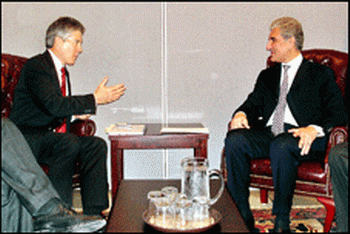
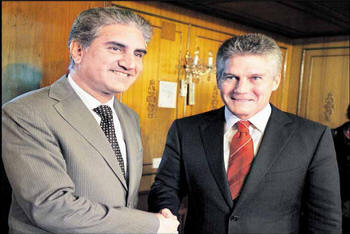
Stephen Smith: Well Minister, thank you very much. Can I thank you very much for your very warm welcome. It is true that you and I have met on a couple of occasions before – in Paris, at the Afghan Donors’ Conference and then in New York at the General Assembly and we also spoke over the telephone in the aftermath of the terrible attack in Mumbai. It is true that we have been working very well and very closely together and I certainly look forward to continuing that in the future.
Australia and Pakistan have been friends for a long time – friends since Pakistan’s inception. Indeed, Australia has had a continuous diplomatic representation in Pakistan since the moment of its inception. In Karachi, Rawalpindi, and now Islamabad and we’re proud of that. But I think the Minister and I both agree that we can do much more with the relationship. We’re friends but we think we can do much more. We can do more to enhance our economic, trade and investment relationship, and the Minister had indicated some areas where there is some expertise so far as Australia is concerned or potential shared interest – minerals and petroleum resources, agribusiness. There are a range of areas where we think enhanced economic cooperation is potentially open to us.
We’re proposing, on a different front, to substantially increase our development assistance to Pakistan. Again in areas where we think we can help build capacity – in child and maternal health care, in eye care, particularly with the Fred Hollows Foundation which is well known in Pakistan, in civil society and promoting democracy and tolerance, which the Minister has referred to.
We’re also very close collaborators, as the Minister has indicated, when it comes to defence, security and counter-terrorism cooperation. I’ve indicated to the Minister that we’re proposing to increase by four times the number of Pakistani defence personnel invited to Australia for training purposes. Our respective chiefs of our armed forces are meeting in Australia in the first half of this year for what are becoming regular heads of armed forces dialogue, and we continue to offer Pakistan as much assistance as we can in these technical and training areas. That’s because we very strongly support a democratic Pakistan.
We very warmly welcomed Pakistan’s return to democracy and, in the aftermath of the terrible assassination of former Prime Minister Bhutto, it would have been very easy for Pakistan to have retreated from democracy. But it stayed the course in very difficult circumstances, and we compliment Pakistan on that and we warmly welcome it. Also, we are one of the original members of the Friends of Democratic Pakistan – the Minister and I both attended the first ministerial meeting in New York to coincide with the General Assembly meeting in September and we continue to play a role on the Friends of Pakistan group.
We spoke about the way in which Pakistan and Australia can work closely together in regional organisations. Pakistan was a strong supporter of Australia becoming a dialogue partner of South Asian Association for Regional Cooperation and with Pakistan’s return to the Commonwealth we propose to work very closely together in the Commonwealth.
We also, of course, have shared interests when it comes to counter-terrorism, in Afghanistan and in the region. One of the things that I have done today in addition to being in Islamabad has been to visit Peshawar to have a briefing from the Commander in Peshawar, and to then travel to the Khyber Pass to inspect the terrain that abuts the Afghanistan-Pakistan border, and to gain an appreciation of the complexities and difficulties that Pakistan has and Afghanistan has and the regional community has in trying to confront and combat terrorism and extremism in the Pakistan-Afghanistan border area.
Australia has 1100 troops in Oruzgan province in Afghanistan, but I think it’s true to say that the Minister and I have a shared view that when one is confronting terrorism and extremism it’s not just enforcement, it’s also civilian construction and capacity building and also political dialogue which is important, both in the case of Afghanistan and the region more generally. This is a strong view that the Minister and I share.
The Minister has referred to the Memorandums of Understanding so far as our respective police authorities are concerned in narcotics and money laundering and these will be formally signed in the near future, but these are additional things to bring to our bilateral relationship.
So Minister, thank you very much for your warm welcome. I know I am the first Australian Foreign Minister here since 1998 and we can’t let that occur again. And to make sure that Pakistan does not have the same record, you are of course invited to come to Australia. I think it’s true to say the only things we didn’t talk about were Australia versus Pakistan in either hockey or cricket, but I very much appreciate your warm welcome and very much look forward to pursuing an enhanced relationship so far as Australia and Pakistan is concerned. Thank you.
QUESTION: You were in Peshawar today and the provincial government there entered into an agreement with outlawed militant organisations. Are you concerned about these agreements or is Australia looking favorably at such agreements with outlawed militant organisations by the Government of Pakistan?
Stephen Smith: As I understand it this is not the first occasion such an agreement has been entered into. I think on a previous occasion on at least one previous occasion the end result has not been a positive or a favorable one. We certainly believe as I’ve indicated combating extremism and terrorism can’t just be military enforcement, it also needs to involve civilian capacity building or civilian reconstruction. And it also needs to involve a dialogue to ensure that moderate participants have the opportunity to take part. That excludes extremists so we hope that what’s occurred is a positive development. Military enforcement or military sanction is not the only way that a positive outcome of respect and regard and tolerance can be achieved. The note I do signal is that in the past we have seen on at least one occasion a similar agreement entered into which hasn’t seen a positive outcome. We hope on this occasion it is a positive outcome.
QUESTION: [inaudible – concerning more troops to Afghanistan].
Stephen Smith: Well the Prime Minister, our Minister for Defence and I have made it clear that at this stage we see our contribution to Afghanistan as being about right. We have nearly 1100 troops there. That is the largest non-NATO contribution. But we also made the point that as we know President Obama’s Administration is conducting a review of its strategy in Afghanistan. And this was the subject of conversation between the Minister and I. One of the things we like about that review is that it encompasses not just the military contribution but the civilian capacity building contribution and the prospect down the track of a political dialogue.
We haven’t yet received any request from the United States Administration for increased contributions so far as military is concerned. But we have made it clear that if we do receive a request for enhanced military contribution we certainly wouldn’t want our contribution to be seen as an excuse for others to not make a comparable contribution or to reduce their contribution. I think it is on the public record and well known that our Minister for Defence has been critical of some NATO countries for not making a contribution in the order of which Australia is making. As I say we are the largest non-NATO contributor.
I have made it clear in the past and I do again that we are very much open to an enhanced capacity building or civilian reconstruction or nation building contribution on the civilian side and we continue to be open for that. We are looking forward to the results of the Obama Administration review and I welcome very much Ambassador Holbrooke’s visit to Afghanistan, Pakistan and India. I also welcome very much the very clear indication he has transmitted which is he is in the business of essentially fact-finding, of listening and learning.
I welcome the fact that my two counterparts for Pakistan and Afghanistan have effectively been invited to go to the United States and make their own submissions to that review – that’s a sensible thing. When we see the results of the review if we are asked to make a greater contribution we will consider that on its merits at the time.
QUESTION: We have talked about enhancing four-fold defence cooperation between Pakistan and Australia and there will be an increase in officer training. There was a proposal from your side to train in capacity building in a similar way that US experts are doing with the Frontier Corp in the tribal areas. Have there been any [inaudible]?
Stephen Smith: One of the attributes that we think we can bring to bear is counter insurgency or counter terrorism. In very many respects regrettably a lot of the Australian post-WWII experience has been in the CT/counter insurgency area in our own region, South East Asia, and then more recently in the Middle East. So we think we do have expertise in that area and believe the most effective way we can transmit or impart that expertise is through training which is why we have embarked upon a substantial increase in the training arrangements that we will make open to Pakistan military personnel.
From my perspective, one of the good things about today when I went to the North West Frontier and to the Federally Administered Tribal Areas was just to get an appreciation of the difficulty of the terrain, the difficulty of the topography, the complexity of the history of the people who lived there, the ease with which border crossings can occur as a natural course of events. These are all attributes that make CT/ counter insurgency very difficult and whilst in the early post-WWII years Australia was in different terrain, we have substantial experience in Afghanistan and in Iraq. I think that through training we can help bring this to bear and this I am sure opens up the prospect of enhanced training arrangements with both Pakistan military personnel, some of whom I met today, who are operating in the Afghanistan-Pakistan border areas, the tribal administered areas and the North-West Frontier.
QUESTION: Your counterpart yesterday clearly indicated that if the Indian side did not respond to certain question the movement of the investigation process would be [inaudible] the courts. Australia has a focused interest in South Asian affairs. The composite dialogue between India and Pakistan is hardened because of the Mumbai attacks. How can countries like yours encourage India to respond to these questions and [inaudible] cooperate with Pakistan so that these investigation can go forward?
Stephen Smith: Can I make this point? Of course Australia has a very significant interest in South Asia. We also have a very significant interest in the Mumbai attack and bringing the perpetrators of that terrible attack to justice because two Australian citizens were murdered in that attack. So we think the priority is this. We welcome very much the production of the information by the Government of Pakistan to the Indian Government in the last couple of days. We think that is a good step. We think the priority is to bring the perpetrators to justice. We also think it’s important that the terrorist groups involved, the LeT, are cracked down on. We think that’s absolutely important.
We also think it’s very important that India and Pakistan work very closely together on this front. It’s important that there are confidence building measures so far as India and Pakistan are concerned and Australia would very much want to see a constructive dialogue between India and Pakistan on the Mumbai investigation. But also the Composite Dialogue resume. And this is a message that I am very happy to give publicly because I have given it privately to my colleague and friend Foreign Minister Qureshi but I have also given it to the Indian External Affairs Minister Mukherjee when I spoke to him by telephone.
We welcome the first steps in the last couple of days. We hope that there is a positive ongoing response to that. We think that it is absolutely essential that the perpetrators of this terrible crime are brought to justice and we would welcome very much a resumption of the Composite Dialogue between India and Pakistan. We regard that as being good for Pakistan and India, but also good for the region, good for Australia and also good for the international community.
QUESTION: Two parts to the question. The first is about Pakistan’s initiative and steps taken regarding the post- Mumbai siege. Do you fully support Pakistan in this regard? And the second part of my question: you slightly touched the sports aspect of the bilateral relationship between the two countries. If you recall earlier the disastrous days of the law and order situation in Pakistan, Australia was the first one who declined to play in Pakistan. So do you have any measures on [inaudible] the relationship?
Stephen Smith: Well, a number of questions there. Three I think. Firstly, on Mumbai I will repeat what I said earlier. We welcome the steps taken in the last couple of days by Pakistan. We think the priority is bringing the perpetrators to justice and cracking down on terrorist groups involved and we think it’s very important that India and Pakistan cooperate on that. We see the resumption of the Composite Dialogue as being very important.
Secondly, when it comes to Australian cricket teams touring Pakistan, the decision as to whether the team tours Pakistan or not is a matter for the Australian Cricket Board, or as it is now known, Cricket Australia. Unfortunately there hasn’t been an Australian cricket tour of Pakistan for a number of years. We look forward very much to a time when Cricket Australia determines that an Australian cricket team can tour Pakistan.
One of the reasons we are working very closely with Pakistan through our very strong support for a democratic Pakistan is because we want to see the terrorist threat to Pakistan reduced to enable the everyday normal activities of life to be resumed. And can I make this point? I very much welcome the comments of President Zardari over the weekend where he made the point that extremism and terrorism in this region is not just a question of a threat to other nations, it’s also a threat to Pakistan and in that respect Australia stands shoulder to shoulder with Pakistan as it deals with a very difficult challenge. And we would hope that Pakistan, with the support of the regional community, with the support of the international community, including Australia, can defeat that threat and meet that challenge to enable the normal everyday occurrences to take place, including cricket, including people being able to go to the Marriott hotel without fear for their lives.
QUESTION: What would Australia need to do to be an effective friend of Pakistan? Particularly in this troubled time?
Shah Mahmood Qureshi: Two things. Australia can help Pakistan overcome its economic imbalance. In my talk to the Foreign Minister I discussed with him how that is possible. We talked about greater market access of Pakistani exports into Australia and one way of doing that is through tariff concessions to Pakistani textiles and goods that are exportable to Australia. That is one way of doing it. The other way is greater Australian investment in Pakistan so that we can generate jobs in Pakistan and we can attain economic stability in Pakistan because economic stability is absolutely vital for political stability and only political and economically stable Pakistan can be focused on extremism and terrorism. And I think that Australia can do that bilaterally engaging with Pakistan, and Australia can do that through the Friends of Democratic Pakistan Forum.
QUESTION: My question is about the drone attacks, by the US in Pakistan and the Pakistan Government is making statements that these drone attacks are counter-productive. And secondly you mentioned [inaudible] what are the elements specifically [inaudible] cooperation with Pakistan?
Stephen Smith: Firstly on the drone attacks; we know, Pakistan knows, Australia knows, the whole world knows that there are extremists and terrorists in the Pakistan and Afghanistan border areas and that needs to be addressed.