Sada-e-Watan Sydney ™
John Howard's
visit to Pakistan
By: DR AHMAD RASHID MALIK
(Research Fellow at the Islamabad Policy Research Institute)
In
recent years, war on terror has pushed Pakistan and Australia toward enhanced
diplomatic and political cooperation that also expanded the existing scope of
economic relations between the two distant neighbours. Moreover, the 8 October
earthquake in Pakistan further led Australia to offer a helping hand for the
humanitarian relief efforts. Australia was one of those countries that swiftly
offered humanitarian assistance to Pakistan and sent a contingent of its
paramedical experts to help rescue quake victims.
About 160 Australian aid volunteers are working in Pakistan to provide
humanitarian services. They are supposed to stay around three months. Australia
has already given about $ 15 million in direct aid while medical team will cost
about $ 20 million over the next three months. In this context, Australian Prime
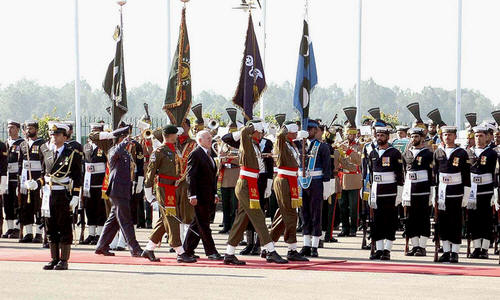
Minister John Howard made an official visit to Pakistan on 21-23 November. While
visiting the quake-hit Muzaffarabad, Howard decided to increase assistance to
Pakistan by offering an additional A$ 50 million for quake victims. This made
Australia's total commitment to the aid relief to A$85 million.
Howard is the second Prime Minister of Australia who made a visit to Pakistan.
Earlier Prime Minister Bob Hawke made a visit to Pakistan in 1989. Nevertheless,
the process of enhanced economic cooperation was started between the two
countries when President General Pervez Musharraf made an official visit to
Australia on 13-16 June this year, the first ever visit by a top Pakistani
leader in 58 years.
Moreover, Pakistan is pursuing its policy of expanding cooperation with the
region of East Asia and beyond such as South Pacific and Oceania to enhance its
economic links with this promising region. Australia is the only country in the
region with high rate of human-centered development as it ranked third in HDI
(Human Development Index).
Prime Minister Shaukat Aziz said that 'Australia can be a bridge between the
developed and the developing countries'. Australia's cooperation with Pakistan
can promote human-centered development particularly in the field of education,
literacy, agriculture and other areas such as livestock and mineral development.
In order to promote bilateral economic cooperation, both countries inked six
agreements and MoUs during Howard's visit to Islamabad that are related to
cooperation in areas of combating transnational crimes, police cooperation,
education, agriculture, mineral cooperation, and trade and economic cooperation.
Education appeared to be a vast area where Australia is interacting with
Pakistan. Howard announced an ambitious $39 million scholarship programme to
bring 500 Pakistani students to Australia over the next five years. The
programme was launched when Musharraf visited Australia in June this year.
South Pacific is still not the focal point of Pakistan's trade. The region
attracts only 1.1 percent of Pakistan's total exports and 2.1 total imports.
Pakistan's exports to Australia have shown a slight improvement over the last
five years.
Last year, Pakistan's total exports to Australia recorded US$ 114 million.
Imports from Australia have been increasing over the past five years. For
instance, Pakistan's imports from Australia accounted 417 million last year that
was an increase of 52 percent from the previous year. Increasing high-level
diplomatic contacts, convergence of strategic views, and bilateral agreements
will further push bilateral trading ties on firm footing. Australian companies
are increasing their presence in Pakistan; particularly the BHP is making
substantial investment in the Zamzama gas field in Sindh, while Tethyan will
carry out a copper mining project in Balochistan.
Howard's visit will also strengthen Pakistan's posture with the wider
Asia-Pacific community. He visited Pakistan just after attending the
Asia-Pacific Economic Cooperation (APEC) summit held at Busan, South Korea.
Howard appreciated Pakistan's army role in quake relief efforts. While speaking
at APEC summit, he said that 'once again we have seen in Pakistan the capacity
of the military forces of that country and the assets of other nation states
which can be deployed by definition, all that much more rapidly than those of
international organisations.
In this context, his visit is just a timely action and it seems that there is a
consensus of views emerging between the two countries on various global and
regional matters. The most significant cooperation exists in fight against
terrorism in which Pakistan plays a central role. Howard expressed his
admiration for Pakistan's 'stoic role in the fight on terrorism' and his fullest
cooperation with Pakistan.
'The visit would soften and help improve Pakistan's image in Australia', Dr
Eamon Murphy, Professor of South Asian Studies at Curtin University of
Technology, Perth, remarked. He said that both Australia and Pakistan are close
allies of the United States in war against terror.
Their cooperation with the United States is key to any such bilateral
cooperation between the two countries. 'Pakistan can not play any effective role
in its region and beyond without seeking full cooperation from the United
States', stated by Aazar Tamana, expert on South Asia at the same university. In
short, Howard's visit has been seen as positive and encouraging development for
the promotion of bilateral ties between the two countries. The visit will go a
long way in deepening cooperation between the two countries in many ways in the
years to come.