Sada-e-Watan Sydney ™
sadaewatan@gmail.com
Exclusive Interview of Pakistani Short Film Producer Sadya Saeed
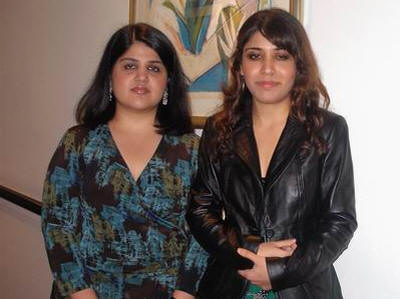
Sania Saeed & Sadya Saeed
1)
When did you come to Australia?
Our family moved to Australia from Karachi in 1987.
2)
What are your current activities?
I have recently majored in Software Engineering from University of NSW. My
sister is majoring in Law from University of Western Sydney.
3)
How did you get into films?
My interest in filmmaking developed after noticing the lack of representation of
multicultural ideas and talent on local Australian TV
shows and movies. But I've come to realise that films are a unique medium for
expression of thought.
4)
What projects have you been involved in?
Our projects have included a series of short interviews - titled 'ToughTalk'
(which is a take off of BBC's HardTalk) (Osama interview-http://www.youtube.com/watch?v=ogrxb_W7e9c)
(Tony Blair interview-http://www.youtube.com/watch?v=xaNE52kmZP0),
a couple of short films (including one in post-production titled 'The Morgue')
and a 90-minute murder-mystery feature film in post-production called 'I Hate
Candy'. The feature film was a momentous task for us, as we did everything from
casting (and several times recasting when some of our original cast dropped
out), getting our small crew together, transportation, location
research/booking, rehearsals, direction) and in post production, we were
involved in editing and music/score. There were times when we were both
extremely frustrated, and many times we were told it would be impossible to
finish, but we made it.
5)
What do you see as the future of films?
Well, as you know, cinema attendance has dropped since film distribution is
spreading to cable TV and the internet now, and businesses and advertisers are
keen to cash in on this market because if you look at it, only people who can
afford high-speed internet are watching movies online right now and these are
the people that advertisers want to target.
6)
What role does media play in politics?
Its been said previously that in future wars will be fought in the media. This
is being seen today in wars such as in Afghanistan and Iraq, however the cost,
unfortunately, is still human. When you hear influential people in the media
openly admitting that they tried to influence public opinion on the Iraq war, it
shows that media is very much in control in regards to how people feel and who
they vote for. However, on the other hand, the internet which is much more of a
peoples' media and cable TV and satellite TV it is getting harder for the big
players to take the general public for granted. It is the 'information' age
after all.
7)
What do you see as the future of Indian and Pakistani films?
Well, both my sister and I are big fans of Indian cinema in terms of
entertainment. And 'Bollywood' is progressing fast in terms of technical and
special effects. Pakistani films on the other hand, are not as popular as
Pakistani dramas. My interest in Pakistani dramas is very recent, after I
watched two or three wonderful serials. There is so much to be done and so much
untapped creativity I believe in Pakistan and the Pakistani community.
8)
What kind of films do you want to make?
We would like to produce films that express our personalities and our humour,
and feelings and ideas. Also films which are informative and which enlighten and
bring about awareness. This is why it is fabulous watching some of the Pakistani
dramas that not only entertain but deal so well with socio-political issues.