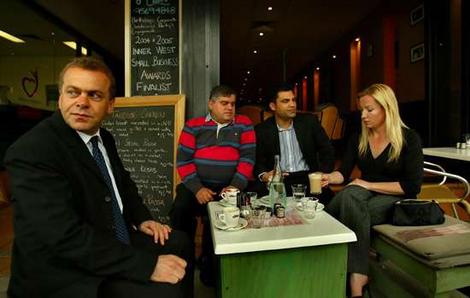
It was a late breakfast for the dozen or
so prominent Muslims who gathered at the Al Aseel Restaurant in Greenacre on a
Saturday in mid-August. Sydney's Muslims were still reeling from the backlash
of the London terrorist bombings. There was a palpable hatred in the suburbs
of Australia's biggest city, and none of the attempts by religious leaders
seemed to be appeasing the media outcry.
The men and women present - among them a
doctor, journalist, teachers and local government councillors - realised that
one of their biggest problems was the limited community response to a wider
audience. Clerics talking about a political crisis were merely throwing fuel
on the flame.
Although the two-hour discussion
threw up few details, organisers say it was the first step towards Sydney's
Muslims finding a voice outside the mosques of Lakemba. The group has met
several times since August and is planning a series of community forums early
next year aimed at sparking a "self-help" approach to redressing the
negativity caused by terrorism. One of the solutions is a greater involvement,
particularly by young people, in mainstream politics.
There are an estimated 200,000
Muslims living in NSW, yet there has never been a Muslim member of Parliament,
state or federal. Across the nation there are more than 300,000 Muslims and
yet only one MP - the Victorian upper house's Adem Somyurek.
Even though Sydney's Islamic
population has been doubling every five years for the past two decades, the
best that democracy and proportional representation have thrown up is 13 local
government councillors in five local authorities. Not that any of them are
seeking the election of a Muslim MP on the basis of religion.
A Marrickville councillor, Saeed
Khan, who organised the Greenacre meeting, partly blames the community itself
for the statistical anomaly. "Our problem is that the community's leadership
has been set up on the basis of religious institutions and Islamic councils,
unfortunately to the detriment of the larger community," the Greens councillor
says.
"The first-generation migrants from
Muslim backgrounds didn't really make an effort to get involved in the
political mainstream. Instead, communities were established around mosques.
That is still the trend even though, from my experience, the majority of the
people are not very religious at all."
Khan and his colleagues say it is a
matter of time; that, like the Italians and Greeks, it takes several
generations to make a mark politically. He cites the election of the NSW and
Victorian premiers, Morris Iemma (Italian) and Steve Bracks (Lebanese).
"There needs to be separation between
religious leadership and mainstream. We are good enough to represent all of
society, not just Muslims. We want to encourage our young people to become
involved in the mainstream; to make sure the system doesn't ignore our
community. If we don't do it now, then Muslim people will be further
disenfranchised and isolated."
Hicham Zraika, a Labor councillor in
Auburn, says he is a realist about the political climate: "Let's face it, if
an election took place now, under the current environment, it would be human
nature to not preselect someone from the Islamic faith. It's common sense."
Then again, religious beliefs should
not influence preselections: "I can't see the relevance in someone being
elected just because [they are Muslim]. The idea must be to represent the
whole, and show that Australians of Islamic faith believe in the process, and
want to be involved and contribute."
Michael Hawatt has already stood four
times for the seat of Lakemba in state elections, the last three as the
endorsed Liberal candidate. He never encountered bigotry while growing up in
Sydney, but does now, including racist tactics during election campaigns when
opponents accused him of hiding his faith from voters because he had
Anglicised his name, from Mahmoud to Michael.
"People are ready to cut your throat
just because you're Muslim," he says. "They try to make you feel guilty as a
Muslim because of the action of criminals. The whole problem is our public
relations image. No one wants to hear anything positive and the Muslim
community is too busy trying to put out fires."
Accusations of racism also flared in
last year's federal election when Ed Husic - a non-practising Muslim - was
preselected as the Labor Party candidate for the southern Sydney seat of
Greenway. In the last days of the campaign, party officials claim there was a
concerted local campaign to keep a "towel head" from being elected.
The Philippine community,
traditionally Labor supporters and strict Catholics, were sent leaflets in
which Husic was portrayed as deliberately concealing his Muslim background and
Bosnian name, Edham.
In a speech to the Sydney Institute
last month, Husic did not blame racism for his loss, but implored political
leaders to denounce fearmongering and vilification of Muslims.
"There's no denying that Muslims in
Australia would like to see someone of their faith elected to Parliament. The
reason is simple: it would send a signal to both moderate and extremist," he
said. "How do we ease the fear that divides people of different faiths? We
need to have a clear view about the future we want. That future is one of
acceptance and inclusion. The biggest step Muslims can take is to recognise
people are scared. They see so-called Muslims doing terrible things to others
in the name of religion. People wonder if they, too, will be a victim."
Shaoquett Moselmane hides his
disappointment in a cloak of political diplomacy. Labor's Rockdale Mayor has
twice missed out on a seat in State Parliament; first to the Sussex Street
decision to parachute the former lord mayor of Sydney, Frank Sartor, into a
safe seat and then to install the former ALP state secretary, Eric Roozendaal,
into the upper house ahead of him.
"It's no use crying over spilt milk,"
Moselmane says. "The issues were dealt with at the time. I look to the future
now and hopefully there will be another opportunity."
So have Muslims suffered because of a
lack of political representation?
Another diplomatic reply: "It's hard
to say … I don't believe the Muslim community has suffered because it hasn't
had a voice, mainly because the Labor Party understand the community. But if
there is someone with Muslim background in Parliament … then it is an
important part of the democratic process. It is not a necessity but it would
be a plus. It could build bridges because it is important to have moderate
voices in this debate."
Canterbury councillor Karl Saleh
agrees: "If we build more bridges between minority groups then we are going to
have a more cohesive society, and a society that allows people to practise
their differences."
Sam Iskandar teaches Arabic at
Marrickville High School and is in his second term as a Marrickville
councillor: "It doesn't matter where you come from as a religion but what you
stand for in society. I don't think of Islam as a political ideology. We are
trying to build this community on mutual respect and working together for the
next generations. The question is how much we stand for social justice."
Malikeh Michaels is a Greens
councillor in Canterbury, an "Anglo convert" who turned to Islam seven years
ago to marry. She now wears the hijab in her official council photograph: "I
put a scarf on two years ago just to identify that I was a Muslim. I wanted to
say, 'Hey, I'm a Muslim and a decent person. I am a mother of two and I have a
law degree.' Sometimes I get a few odd looks but there hasn't been an adverse
reaction."
Michaels says the main reason Muslims
have not made a mark politically is the background to their arrival. "Many
came from refugee backgrounds and until now have been caught up by the
struggle of everyday living, so they haven't been participating fully as
citizens. The challenge for the next generation is to begin to move in that
direction, hopefully having confidence in the political system."
The Department of Foreign Affairs
website describes the growth rate of Islam in Australia as "remarkable". The
2001 census showed a 40 per cent increase in the Muslim population over five
years, compared to a 5.7 per cent growth in the country's total population
over the same period.
It also showed Muslims come from more
than 70 countries, which is why forming a Muslim political party, as was
attempted unsuccessfully in Canberra recently, would be a mistake, say Michael
Hawatt and others.
"We do not exist of one race," Hawatt
says. "Each nationality has their own ideas, influence and problems. If you
try bringing a single representative for Muslims it wouldn't work."
Khan agrees: "It would send the wrong
message, particularly to our own youth. We need to get over the hang-up in
this country about being Muslim. We want to be a part of the mainstream, not a
side issue."