THE HON JOHN HOWARD MP
ADDRESS AT LUNCHEON FOR THE PRESIDENT OF THE ISLAMIC REPUBLIC OF PAKISTAN
HIS EXCELLENCY GENERAL PERVEZ MUSHARRAF AND HER EXCELLENCY MRS SEHBA MUSHARRAF
GREAT HALL, PARLIAMENT HOUSE
John Howard:
Your Excellency General Pervez Musharraf, the President of the Islamic Republic of Pakistan, Mrs Sehba Musharraf, Leader of the Opposition, parliamentary colleagues, ladies and gentleman. Today marks a first in relations between Australia and Pakistan. This is the first occasion that we have been graced with a visit to our country by a Pakistani head of state, who of course is also head of government of that country. And I have a very special pleasure and a very deep feeling in welcoming President Musharraf to Australia. In saying on behalf of all of us how much we admire the exceptional personal courage that he has displayed in recent years.
It’s easier to make brave rhetorical speeches about the values of freedom and democracy and the rights of man when you belong to a country with whatever other faults it may have has always had a long uninterrupted tradition of peaceful political exchange – however rumbustious it may get in a verbal sense on occasions. But to be the leader of a country and to survive two assassination attempts within a short period time, and to know that there are people within your country whose only goal is not only to remove your government, which you can understand in a democracy, but also to remove it with violence and with force and, if necessary, including your removal from this life. So I pay tribute to somebody who has come through the fire of violent challenge to his position, somebody who has played a major role in the fight against terrorism, somebody who has understood the need to confront and
defeat the extremist elements within our society, and they are to be found in many societies that seek to visit death and terrorism on people around the world.
And also I salute somebody in President Musharraf who has led a transition of his country to a democratic state. Pakistan has not always been democratic, something that the President himself freely acknowledged that any reading of history would tell us. And I do not think enough credit has been given to Pakistan under President Musharraf’s leadership for the transition that has occurred over recent years. And many of you will have heard me say in this very hall, this Great Hall of our Parliament, not so long ago when welcoming our friend President Yudhoyono of Indonesia that insufficient credit had been given to Indonesia for her great transition to democracy. It can be said with equal force that insufficient credit has been given to Pakistan for her transition to democracy. And these two great Islamic countries, both of whom’s future as pillars and exemplars of moderate Islam, is so important
to winning the battle of ideas against the extremist elements around the world. The success of the democratic transition and democratic process in Pakistan is no less important to us and to many others as it has been in Indonesia.
The President also deserves our special praise and understanding for the contribution that he has made in bringing about an improvement in relations between India and Pakistan. We all know from our reading of history the tragic circumstances in which India was partitioned in 1947. And out of that partition came two nations; one of which Pakistan was again in 1971 to divide herself into Pakistan and Bangladesh. And the experience of people living and leading those countries over those years has been very difficult. And the vexing problem of Kashmir and all that has flowed from it has been with the leaders of India and Pakistan now ever since the partition in 1947. Yet over the past little while due to the great efforts of President Musharraf and the great efforts of the Indian Prime Minister, Mr Singh, both of them deserve our credit and our praise because they have contributed in their
different ways towards an improvement in their relations. And I can say for reasons you will understand how wonderfully symbolic it was, as well as the reality it carried, that the latest stage of the rapprochement between India and Pakistan was sealed while the leaders of those two countries were watching a sporting encounter between India and Pakistan – in which Pakistan ultimately triumphed. And of which the President has said much to me during our discussions over lunch. And the third thing that I believe, and it really flows from the first, the President deserves credit, is the contribution he’s made through the restoration of democracy for the readmission of Pakistan to the full Councils of the Commonwealth, from which Pakistan was suspended in 1999. And I look forward to joining him at the next Commonwealth meeting in Malta.
Australia and Pakistan have many links of history and culture. We have many values in common. We share an inheritance to which both countries owe much to the British connection. But we share most importantly in 2005 a common commitment to fight terrorism, and also a common commitment to see an improvement in the living standards of the less developed countries of the world, of which plainly Pakistan is one. And the rich nations of the world, of which Australia is undeniably one, have obligations to the poor nations of the world. We have obligations of aid, we have obligations of helping to spread democratic institutions, we have obligations of helping to spread the advantages and the values of education, we also have obligations of helping to spread in many countries the values and the benefits of good governance. Aid not coupled by good governance can often be aid wasted and spoilt
and aid given in those circumstances can cause disenchantment within the domestic populations of the countries that provide that aid. We also have an obligation to pull down trade barriers and I’ve said on many occasions that removal of trade barriers, especially those barriers which unfairly impact on the agricultural exports of developing countries, can do more to assist those countries than the provision of increased overseas aid. That is not to say that there is not a case for the latter, but the former will deliver more benefits.
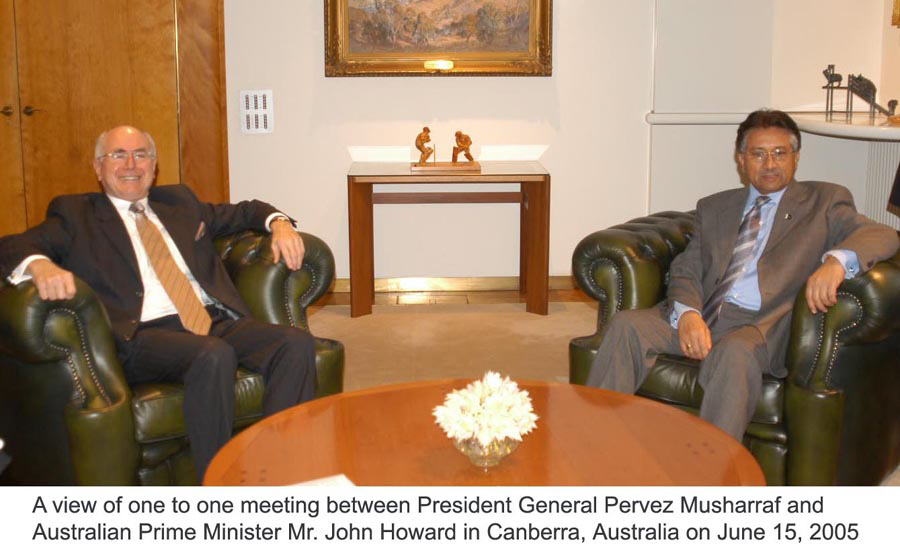
Mr President, you and I have had, and I use a well worn diplomatic expression, but I really do mean it, we have had some very full and frank discussions, I’ve enjoyed the ease with which we have been able to share our views on our common values, our common history and the common challenges that we confront. I’m very pleased that we’re able to sign some Memoranda of Understanding, one in relation to agriculture which will provide some $6.6 million over four years for Pakistani agricultural industry, an MOU on counter-terrorism, and an MOU between the Australian Securities and Investment Corporation and its Pakistani counterpart to provide greater investor protection, because encouraging confidence amongst foreign investors is an imperative for all countries that seek to attract foreign investment to their shores. And I’m also, in the context of the great importance we attach to educational
institutions and connections, I’m very pleased to announce that Australia will provide 500 fully funded scholarships over the next five years for Pakistani students to study at Australian universities. There has been no finer thing done by this country to enhance relations between Australia and the nations of our broader region than the Colombo plan established all those years ago, and the spirit of that plan in its many manifestations lives on and we continue to be very committed to the extension of educational links between our institutions and the people of our region.
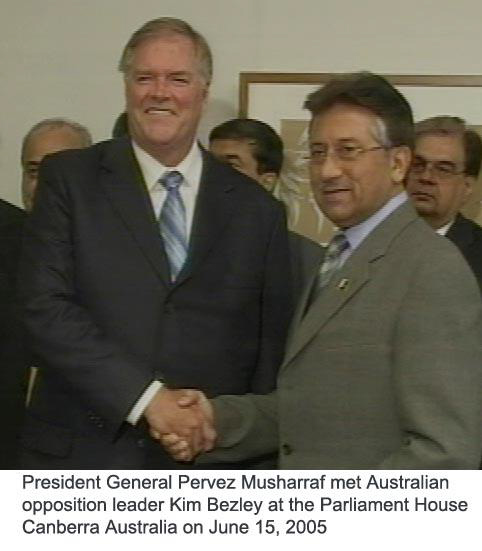
Mr President, you are a very welcome visitor to our country. I hope out of this visit we can build a lot. I remarked to you earlier that Australia and Pakistan are countries that have a lot in common but haven’t had a lot to do with each other in recent times. We’ve got to something about that and I believe that this visit is a start and it’s all the more likely to be a start because of the very real personal contribution at great risk that you have made to some things and some values and some outcomes that we hold dear and we hold in common. In that spirit you are very welcome and I invite Mr Kim Beazley, the Leader of the Opposition, to support my remarks.
Thank you.